Notes on Becoming a Wildlife Detective
Sustainability
First-time animal trackers at Smith College learn some secrets of the outdoors

Photos by Jessica Scranton
Published January 28, 2026
On a sunny afternoon in January, eight of us walk single file along an icy trail at Smith College’s MacLeish Field Station in search of the perfect animal track.
The air is tranquil, and the light is hazy. Our attention is fixed on the ground, where there is still enough snow cover to spot prints around the base of trees and along the path (squirrels? dogs? deer? rabbits?).
On the 20-minute van ride from campus to the field station, we learn that a bobcat was spotted recently near student residences on Paradise Road—raising hopes for what we might discover out here in the woods.
Our guide, Scott Johnson, Smith’s Outdoor Adventure Program manager, aims to keep us first-time trackers realistic. “I haven’t done any advance scouting,” he cautions, as we clamber out of the vehicle and slide crampons over our boots. “There are no guarantees.”
As we head out along the trail, we mentally review the checklist Johnson shared in the previous day’s Animal Tracking workshop. A critical piece of that received wisdom: It’s not merely the print that helps identify the animal, it’s also the tread, the terrain—the total picture of how they move through the landscape.
In that first session, we talked about the types of wild mammals that inhabit our region—and those that don’t (coyotes are a yes; wolverines, a no). We learned about animal families (ungulates, rodents, lagomorphs); varieties of scat (“from pencil lead to M&Ms”) and different animal gaits (rabbits gallop, weasels are bounders, and deer move diagonally in “perfect stepping”).
Effective animal trackers are wildlife detectives, Johnson emphasized, “thinking in an analytical way,” and eliminating suspects from their inquiries.
An easy example: Is this pawprint from a cat or a dog?
A. Canine prints have claws; feline prints do not, since cat claws are retractable.
A harder example: Is this track from a coyote or a domestic dog?
A. Wild animals are efficient and purposeful, leaving fewer tracks, and they are also more consistent in size.
Practicing on campus for the more ambitious tracking session at MacLeish, our group of 20 students and staff examined muddy tracks and two different piles of scat in the Smith boathouse (“I can cross this off my bucket list,” said one senior, with a smile, as she entered the wooden structure). At least one pile most likely was left by a muskrat, Johnson said.
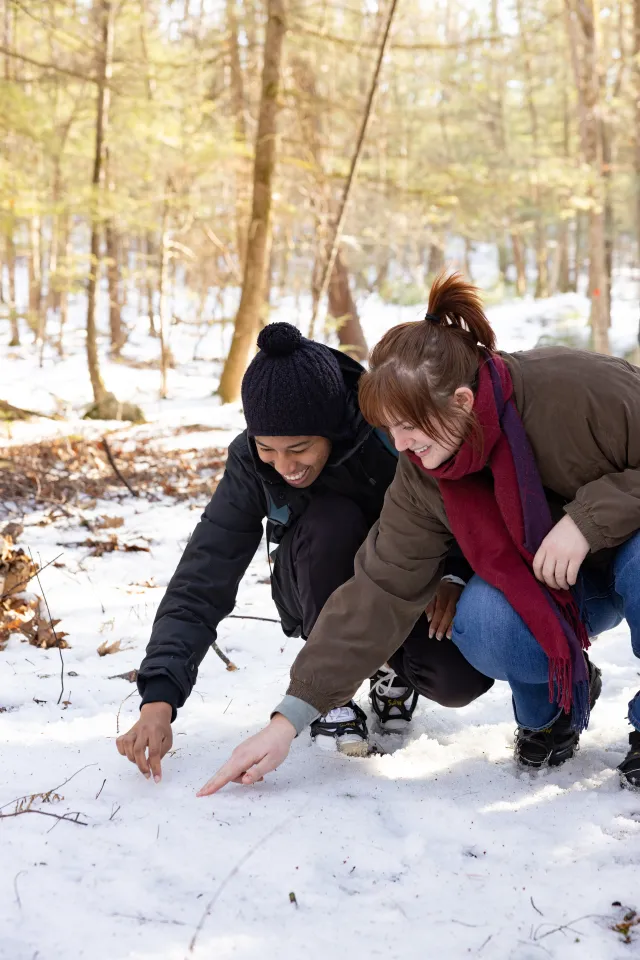
We also spent time looking at vole tracks, like tiny frozen highways in the snow, and numerous pawprints along the edge of Paradise Pond and the Mill River (dog, dog, dog, squirrel). We practiced putting our hands inside the tracks to feel for the presence of claws.
While many people study tracking with the intent to hunt, Johnson says that for him, it’s an “invaluable skill” for understanding and connecting to the landscape.
“It makes a casual walk through campus or the woods much more interesting,” he says. “Many people come here from far away and are often surprised by how what they learn in this workshop applies to where they come from—even other countries and continents.”
Of the initial 20 workshop participants, eight of us signed up for the second-day tracking session at MacLeish. And here we are, hushed and determined, picking our way over boulders and downed branches on a slope off the side of one of the main trails.

We’re not exactly sure what we’re looking for, but we sense it’s going to be something other than the ubiquitous squirrel and dog tracks. At the top of a rocky outcrop, Johnson points to a stand of conifers that looks stunted compared to others in the vicinity (a major clue, as the glossary at the end of this story explains). Some steep steps below, he shows us some scat in a small cave formed by the rocks.
“Any idea what animal might have been here?”
We venture some guesses: “Coyote? Fox? Raccoon?”
Then, Johnson pulls something out of the rock cave—evidence so clear it makes us gasp: A silvery porcupine quill. Looking closely, we notice several other quills glinting in the weak afternoon sunlight, and some tracks with a telltale gait nearby. (Fun fact: Porcupines pee while they walk, emitting a “sweet” odor compared to the downright “offensive” smell of coyote pee, Johnson says).
The porcupine find inspires us, and we scatter more confidently across the terrain, alert for smells, trampled vegetation, scratched tree trunks and other signs of wild animal activity.
We are rewarded with the sight of some big pawprints not far from a pile of scat deposited boastfully, in true canine fashion. The tracks are straight and purposeful as they extend into the tree cover.
“This is a big animal,” Johnson says, spreading his hands to measure the distance between prints.
We quickly reach consensus: These are wild tracks, probably a coyote’s.
Our journey ends where the woods meet an open meadow—one of those “transitional areas” that Johnson says are ideal for finding tracks. The temperature is dropping, but we are warmed by our newfound success as wildlife detectives.
On the van ride back to campus, we quietly reflect on our afternoon’s adventure. One thing is for certain: Walks in the woods will never be quite the same.
Tracking Glossary
Ungulates (2 toes): A hoofed mammal, including deer, moose, horse.
Rodents (5 rear toes/4 front): Gnawing animals, including squirrels, rats, mice, porcupines and beavers.
Lagomorphs (4 toes): Hares and rabbits.
Stunted conifers: A potential sign of a porcupine habitat, since porcupines eat the bark, needles and buds of conifers—especially in winter.