A Literary Passion Project
Students
A Cromwell Fellowship helped Smith College senior Anne-Marie Martin delve into the work of sci-fi writer Octavia Butler

Anne-Marie Martin ’26 stands in the science fiction library on campus, located in the basement of King/Scales. Photos by Jessica Scranton
Published May 13, 2026
When Anne-Marie Martin ’26 was young, she lamented the lack of Black sci-fi or fantasy writers on the shelves. “I went to a lot of predominantly white institutions, so I never got a lot of exposure to Black authors,” recalls the Smith College senior. “The Black authors whom I was exposed to, such as Toni Morrison and Alice Walker, wrote about ugly realities, whereas I was interested in fantasy.”
Her mom’s response then? “‘Excuse me? How do you not know about Octavia Butler?’”
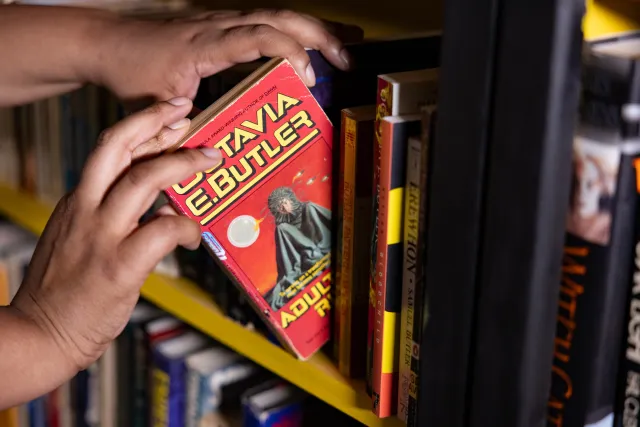
Fast forward to this year, when Martin has spent part of her final two semesters completing an independent research project about Butler and her work, utilizing the iconic author’s own papers from her literary archive at The Huntington Library, Art Museum, and Botanical Gardens in California.
Her mom’s response now? “She was so proud and really excited,” Martin says. She told me to make sure that I take lots of pictures.”
(Martin listened: while conducting her research at The Huntington, she took over 1,700 photos of Butler’s manuscripts, articles, notes, and other personal papers.)
Martin’s research experience began taking shape through a seminar class called Black Magic: Africana Encounters with the Paranormal, taught by Professor of Africana Studies Crystal Fleming. A chemistry major, Martin was convinced to take the class by the opportunity it offered to do a final project on Butler and her work.
“I feel such a kindred spirit with [Butler],” Martin says. “She was a Black woman, she had dyslexia like me. I was really inspired when I saw that this person who was an amazing writer also had trouble with spelling and writing herself. Sometimes I get sad when I remember that I’ll never be able to meet her.”
Butler passed away in 2006, but The Huntington’s archive dedicated to her work offered Martin the next best thing to meeting the author she so admires. When she first learned of the archive, though, Martin considered it to be a pipe dream, something she’d never actually be able to explore firsthand.
That is, until Fleming introduced her to the Cromwell Fellowship. Funded by the Department of Africana Studies, the fellowship is open to students completing research or work on Black studies. After being chosen for the fellowship, Martin soon found herself immersed for a week in the work of her favorite author.
“There were so many little tidbits and treasure troves,” Martin says of examining Butler’s work through her papers. “I liked looking at her notes because she would leave little notes to herself: ‘be powerful,’ ‘move people,’ ‘this is big,’ and I’d get to see her thought process. Everything was hers. Every curve, every line, every rip is Butler’s.”
“I liked looking at her notes because she would leave little notes to herself: ‘be powerful,’ ‘move people,’ ‘this is big,’ and I’d get to see her thought process. Everything was hers. Every curve, every line, every rip is Butler’s.”
Martin’s research focused on Lilith’s Brood, a series that is not as popular as Butler’s other work. Originally published as the Xenogenesis Trilogy, the novels tell the story of humans who have been “rescued” by an alien race called the Oankali following a nuclear apocalypse and how their survival hinges on their acceptance of genetically merging with the Oankali. While most scholars focus on Butler’s more popular novels like Kindred or Parable of the Sower, for Martin, the trilogy held a special kind of appeal.
“It’s my favorite, and the first of her books that I ever read,” she says. “It’s also got just as powerful a message [as Butler’s other books]... I focused on her content generation, [research], and outlining process, as well as the development of a main character from Adulthood Rites, … really delving deep into the questions she posed and how she came up with them.
“This was my first time doing archival research, and it’s interesting because she just had so many notes and drafts and ideas… I’ve actually read two different versions of the second book [Adulthood Rites] now just through her notes.”
Martin’s work is nothing short of a passion project—one that was recently honored by the Department of Africana Studies. Just a few days before Commencement Weekend, Martin received an email that she had won the Ida B. Wells Prize for Distinguished Work in Africana Studies.
“It’s so big and [I had worried] it might be a little all over the place,” she says of her work on Butler, “but I’m really proud of it. I’m really happy to look back and see the culmination of everything I did.”