Hooray for Trees!
Faculty
Smith College biology professor Jess Gersony co-created a new environmental art exhibit at MASS MoCA that opened with a pep rally and marching band to celebrate the merging of art and science

Jess Gersony and environmental artist Amanda Lovelee with the two newly planted red oak trees at Mass MoCA. Photos: Jessica Scranton
Published June 29, 2026
Jess Gersony, assistant professor of biological sciences, is as much an artist as a plant physiologist and often uses art with her students as a teaching tool. She even formed the PLACE (PLant physiology, Art, and Community Engagement) Lab at Smith College to explore how plant and environmental science, art, and education can all inform one another.
Gersony’s approach caught the attention of environmental artist Amanda Lovelee, who emailed Gersony out of the blue to ask if she’d work with her on her latest exhibit, titled “Homecoming,” for MASS MoCA, in North Adams, Massachusetts. “I got an e-mail back saying, ‘Yes! This is my dream email,’” says Lovelee. “The more I learned about how Jess was using art in the classroom and with the PLACE Lab, I knew I had met a lifelong collaborator.”

Celebrating the planting of the trees with a parade and pep rally.
Lovelee’s series of “Homecoming” exhibits are outdoor environmental projects with local partnerships and site-specific programming. “I have watched climate change get more and more political,” says Lovelee. “I was trying to think of a bipartisan way to gather people with joy to think about and move toward climate action.” Past exhibits have included one on an endangered snail in Door County, Wisconsin, and a tribute to a tree that burned during the 2020 protests in Minneapolis. For the MASS MoCA exhibit, Gersony was the scientific half and Lovelee the artistic half—though both roles were every fluid.
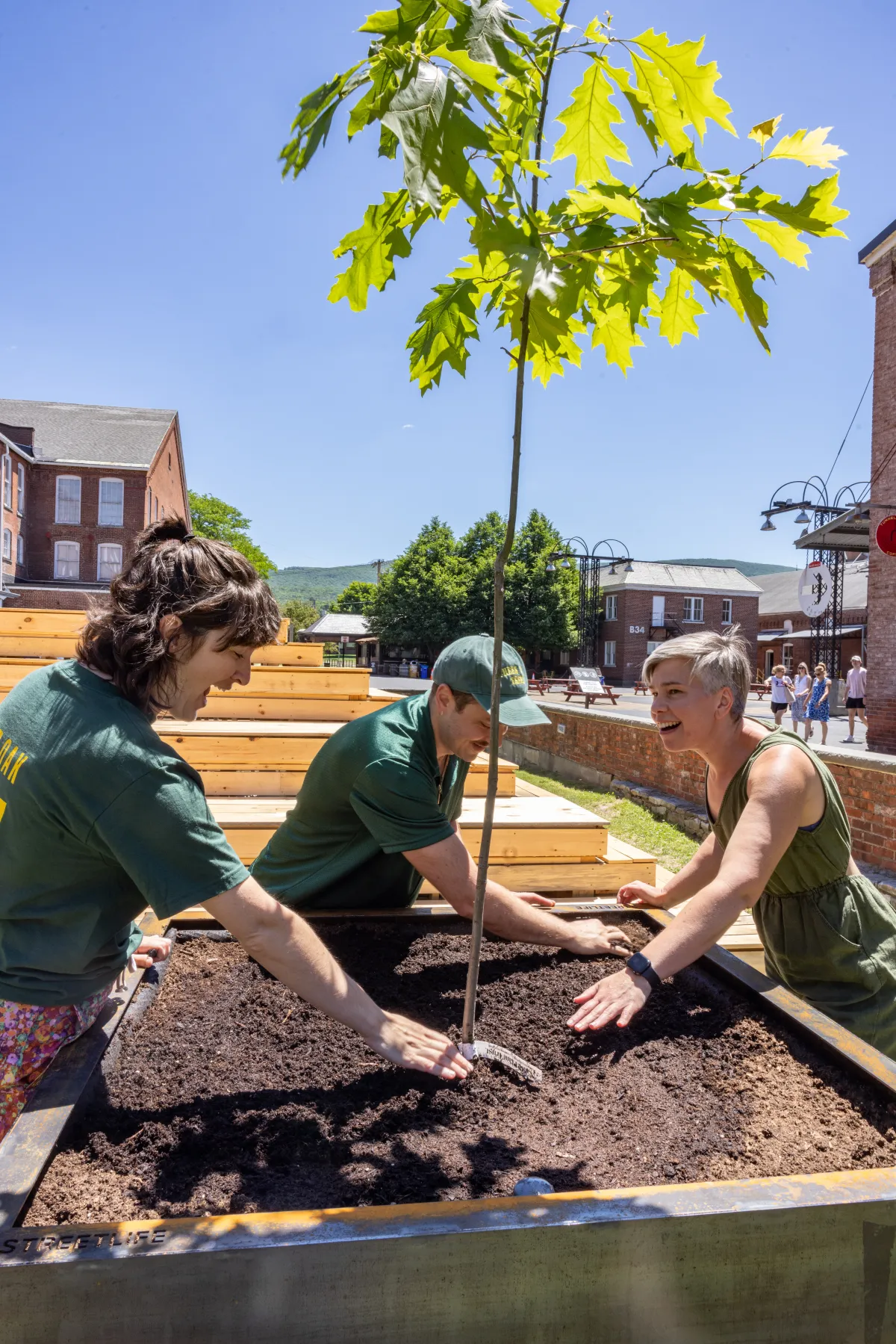
For their collaboration, Lovelee and Gersony planted and potted two red oak trees at the entrance to MASS MoCA. Bleachers are nearby so visitors can watch the trees grow. One red oak is from Massachusetts, and the other is from the southeastern part of the United States. “The idea was to do an exhibit focused on an issue that’s relevant to our northeastern forests here in Massachusetts,” says Gersony. “It’s a celebration of northeastern forests, and a celebration of climate solutions.”
The hope is that the two red oaks will bring awareness to one climate solution: assisted migration, which is the human-assisted movement of plant species or populations to new areas when they can’t migrate fast enough on their own to survive shifting climate conditions.
"When we bring plants up from the South, they are in new communities with northern plants and there are many ways they can communicate with one another. One of the ways they communicate is through their leaves through volatile organic compounds (VOCs), which are essentially like smells, hormones, and pheromones that plants release into the atmosphere, and other plants can sense,” explains Gersony. “Trees can communicate if stresses are coming, and what they should do to acclimate.”
Assisted migration is being researched and implemented across the United States. With funding from the National Science Foundation, Gersony and her students are working in collaboration with researchers at the University of New Hampshire and Alabama A&M University to study the climate resilience of trees from the southern and northern United States to optimize the practice of assisted migration.
Chlo Gold ’25, a research technician at the PLACE Lab, was charged with finding a red oak from the Southeast to pair with a northern red oak. “I spoke with countless nurseries from the Southeast on the phone, sent dozens of emails in search of a red oak sapling that was native to the area, and similar in size to the northern tree we had already picked out,” says Gold. They finally found one at Mellow Marsh Farm in Siler City, NC, which, coincidentally, specializes in propagating southeastern native plant species for ecological restoration and wetland mitigation. “I was especially drawn to them for their mission,” they say, “and was doubly excited when they had the perfect oak sapling to join its northern counterpart.”

PLACE Lab members, left to right, Kelly Malone-Wolfsun, Marge Poma Alarcon ’23, Chlo Gold ’25, and postdoctoral researcher Malini Muthu Karpagam, show off the variety of zines they created for the exhibit.
Gersony’s students played a significant role in creating the exhibit, including writing text for several educational zines available at MASS MoCA that cover various topics such as climate change, VOCs, and assisted migration. Students from Massachusetts College of Liberal Arts worked on the final design and printing.
Gersony is thrilled that she and her PLACE students have been able to bring art—and science—to an audience beyond the classroom. “The issues are important and close to my heart,” she says. “I believe this exhibit will have a much bigger reach than an article in a scientific journal. The MASS MoCA exhibit is free and accessible to the public because it is right in the front of the museum, so tens of thousands of people will walk by it every year.”
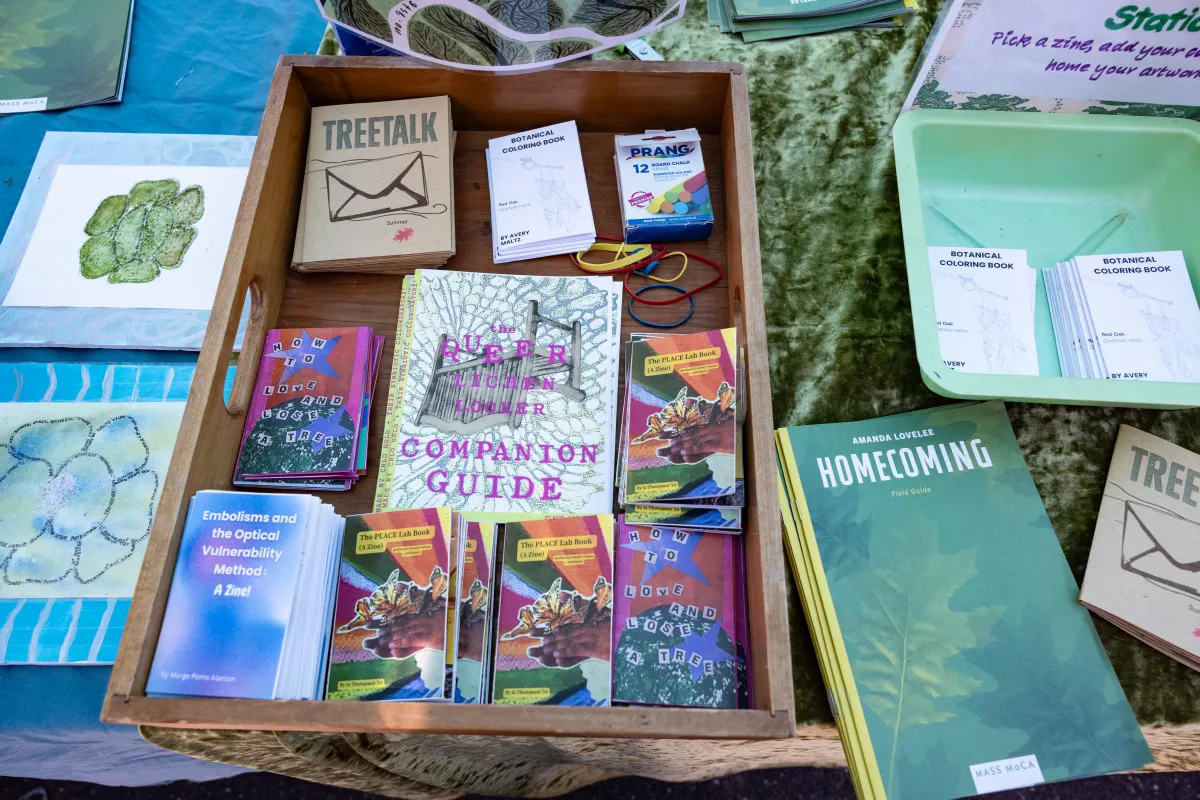
In that spirit, the “Homecoming” opening at MASS MoCA on June 13 included a massive celebration—or pep rally—with marching bands, a parade, and family-friendly activities and performances.
The pep rally theme is a signature of Lovelee’s exhibit openings because she considers the merging of art, science, and community as a reason to celebrate environmental resilience and show support for the future of our planet. “If we can come together with pride to cheer for a local sports team, why can’t we cheer for trees, water, or for an endangered snail?” asks Lovelee. The positivity of the pep rally makes sense to Gersony, too. “It’s really celebrating nature,” she says. “We know what we’re [fighting] against, but we can also galvanize and cheer for something we love.”
“Homecoming” at MASS MoCA runs for the next three years, and, since it is on the museum grounds, is free to the public.