Summer at Kew
Students
Beatrice Tauer ’27 pairs her Smith College education with hands-on experience at the legendary botanic garden

Published July 16, 2026
One of the most coveted summer internships for Smith students is at the Royal Botanic Gardens, Kew—a UNESCO World Heritage Site spanning more than 300 acres in London. Home to over 50,000 living plants, it is one of the most biodiverse places on Earth. Through a generous endowment in honor of Muriel Kohn Pokross 1934, The Botanic Garden of Smith College chooses two Smith students each year to work alongside Kew scientists on projects in molecular biology, conservation genetics, and bioinformatics. Some Smith students have even co-authored scientific publications resulting from their research.
This summer, Beatrice Tauer ’27, a biological sciences and statistical and data sciences double major, landed one of the plum spots. Here she shares her thoughts about the experience and how Smith prepared her for what she considers the opportunity of a lifetime.
Why Kew Gardens?
“Kew is home to one of the largest herbarium collections in the world. Being able to apply statistical and molecular techniques to these specimens allows us to increase our understanding of taxonomy, evolution, biodiversity, and ongoing threats. I feel so lucky to be able to do this work with such a great team. This internship, which is run through the Smith Botanic Garden, is an incredible opportunity for botanical- and molecular-biology-minded Smith students.”
Daily duties.
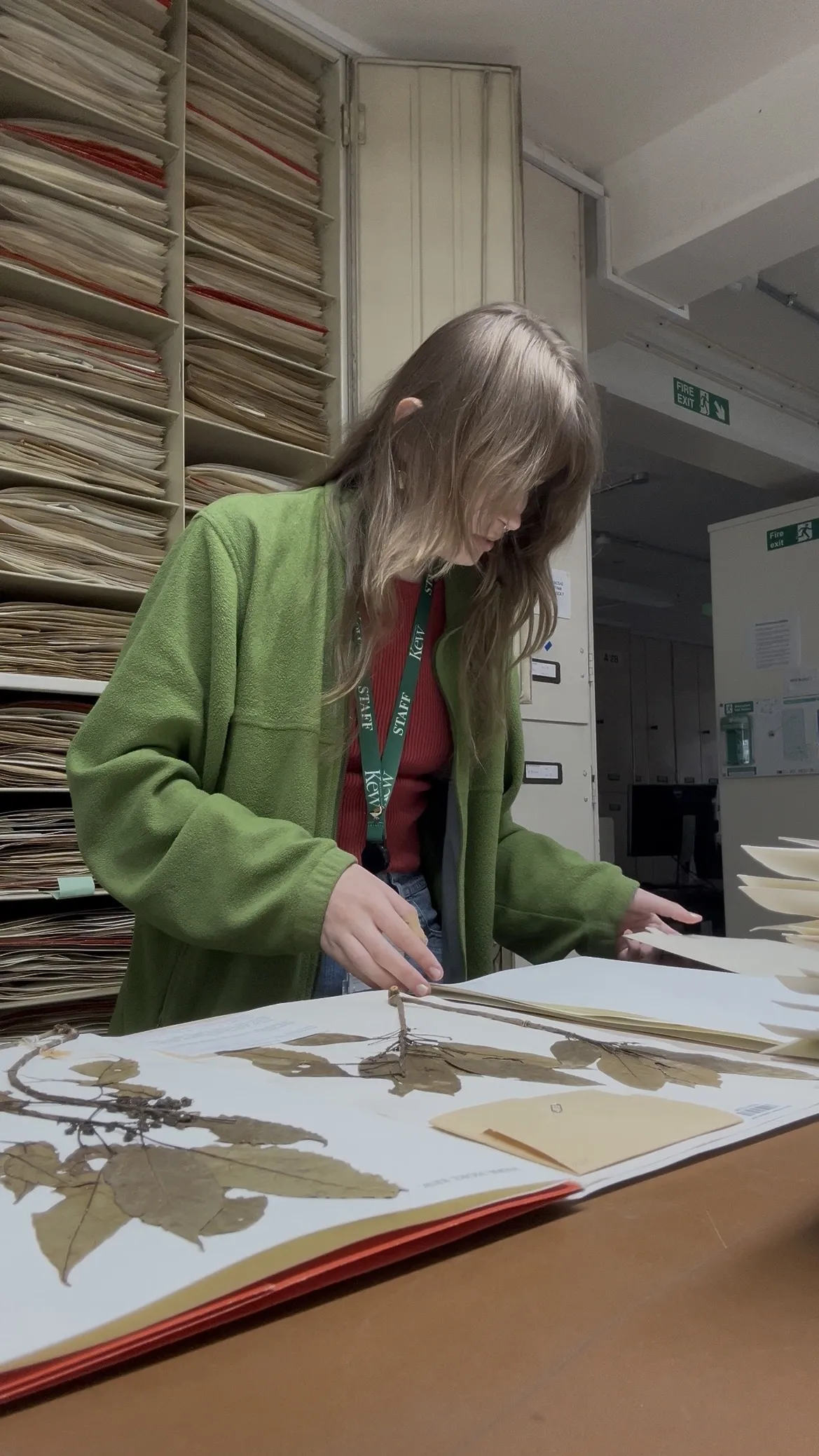
“At the beginning of my internship, most of my time was spent in the herbarium going through folders of specimens, many from the 1800s. This allowed me to familiarize myself with the genus my project is focused on, Macaranga. After developing a baseline understanding of the species, my days have become more varied in developing different aspects of this project. I work on collecting material from specimens of interest, identifying specimens that have yet to be categorized, finding misidentified specimens, performing statistical analysis of the collection and biogeographic analysis of the species, extracting DNA, and doing anything else that needs to be done to move the project forward.”
Favorite part of the internship.
“I’ve been really enjoying how much of this project I have been able to develop and getting to explore areas that interest me—if I can fit the work into the internship timeframe. This freedom has allowed me to take the project in new directions and aid in the development of both research questions and methods to answer them.”
Most surprising discovery so far.
“Because I’m working with so many species endemic to Madagascar, many of the specimen descriptions were written in French. I didn’t realize how many words there are to describe a plant specimen, and I didn’t expect to need to learn them in both English and French!”
Smith prep.
“My coursework in biology and statistics has given me a great baseline to pursue research in bioinformatics and molecular biology. Additionally, as the intern for the Smith Center for Molecular Biology, I learned many of the lab skills that I am using now to help recover historical DNA from herbarium specimens. But I’d say more than specific skills, the ability to pursue research at Smith gave me a great perspective for how to approach a new research project.”
Internship perks.
“There are so many interesting talks on research being done at Kew and beyond. I recently got to listen to many of the talks at the State of the World’s Plants and Fungi Symposium hosted by Kew.”
Favorite way to unwind.
“I usually unwind with my current book, as I was able to get a library card for my time here.”
Favorite night out.
“London has some lovely social dances. I’ve gone to some swing, ceilidh, and line dances.”
Advice for Smithies looking to intern at Kew Gardens.
“My number one piece of advice is simply to apply even if you don’t feel qualified. This internship is a great opportunity to develop skills for anyone aiming to pursue a career in research. For more info about the application cycle keep an eye out for the Q&A session in the fall or reach out to the Smith’s Botanic Garden manager of education.”
The best part of my internship is...
“getting to contribute to an herbarium collection that was established nearly two centuries ago and will last for much longer still.”