Rose Jang Is Rebuilding Her Voice
Smith Quarterly
Once poised for global stardom, the class of 2001 alum lost her ability to sing after a near-fatal accident. An innovative rehabilitation treatment could help her return to the stage.

Photographs by Tess Mayer
Published February 10, 2026
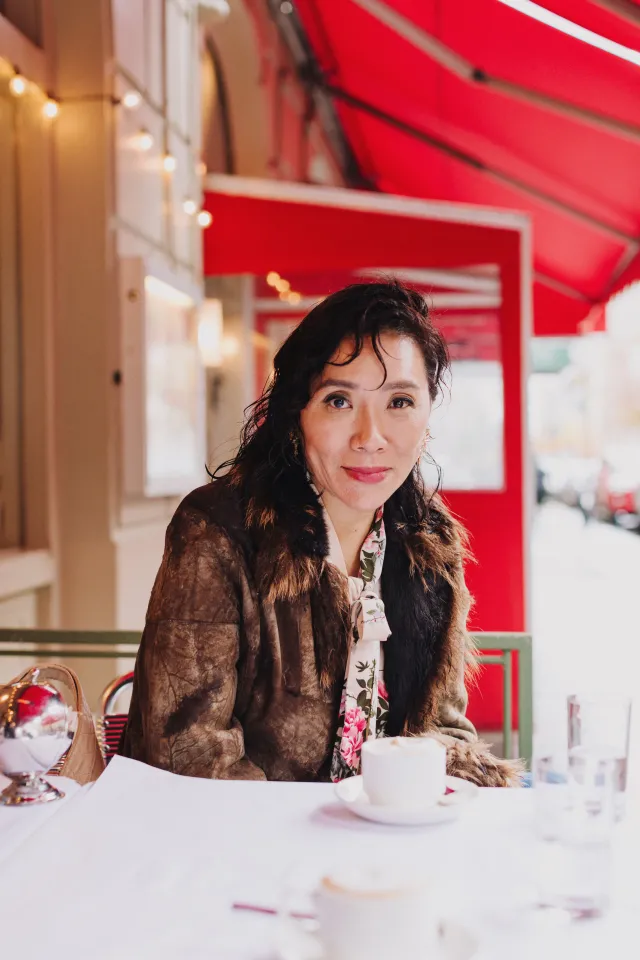
On a warm October afternoon, Rosalyn (Rose) Jang ’01 walks from her apartment on New York’s Upper West Side to one of her favorite haunts, Café Luxembourg, a cozy French bistro frequented by celebrities. She moves slowly, dragging her right leg—but she is walking, which is nothing short of a miracle.
The staff inside the café greet her with warm smiles and familiar hellos. But many of the patrons might not realize that they’re in the presence of a woman who once performed for dignitaries around the world and in just about every major concert venue from Carnegie Hall to Wembley Stadium.
All of that changed in an instant five years ago when an accident nearly claimed her life, severely limiting her mobility and leaving her barely able to speak, much less sing. But Jang refused to accept that fate. She fought her way back through multiple surgeries and relentless physical therapy. And now, she’s embarking on a cutting-edge brain-computer interface rehabilitation program—one that just might help her reclaim her voice and set the stage for a remarkable comeback.
The daughter of Korean immigrants, Jang grew up in Princeton, New Jersey, absorbing the tenacity, creativity, and ambition of her parents. Her mother, Carolyn Bok Jang—a former Ford model turned designer—worked with Argentinian jeweler Carlos Alemany during his collaboration with Salvador Dalí, in addition to serving as a model for the artist. Her father, Daniel, a biophysicist who earned a doctorate from Princeton University, pioneered extended-release drug-delivery systems and founded VITAMINJUICE, a nutrient-enhanced drink company now run by Jang’s older brother, Andrew. “Rose and I were always close,” Andrew recalls. “Our parents were both entrepreneurs, so after school it was just the two of us.”
Growing up, Jang played violin and took acting classes. When it came time to choose a college, Smith was at the top of her list. “I wanted a liberal arts education because I wanted that all-encompassing kind of education,” she says. “And I wanted a women’s college.” Her mother had just purchased an apartment in New York, and, being an art history major, Jang attended every gallery opening she could—both in Northampton and New York City. After graduation, she slid seamlessly into the city’s art world, working at an auction house, at her mother’s jewelry studio, and, eventually, in the Diamond District.
But she couldn’t shake the strong desire to be onstage. She began auditioning for theater roles and, on a whim, took a voice lesson—and that changed everything. Her teacher was stunned by Jang’s powerful and pitch-perfect vocals. “Until that day, I didn’t know how good I was,” Jang says. Singing had always been her “ultimate dream.”
She recorded demos that caught the ear of Korean trot producer Kim Hyun Woo, and recorded a few trot songs with him. But the genre, with its bouncy, easy-to-sing rhythm, ultimately felt too confining for her operatic tone and nearly four-octave range. By 2003, she was living in South Korea full time, and even though she was still learning the language, Jang soon landed an understudy role in a Korean production of Urinetown: The Musical. “I immersed myself in the culture. I learned about my heritage, about entertainment and singing—everything was new,” she says. Her father became her manager. “He was determined to make me successful in Korea, and he achieved that,” she says.
Concert offers quickly outpaced her theater commitments, and Jang began touring across Korea, China, and Japan—often performing with the Seoul Philharmonic, Korea’s premier orchestra. She recorded several CDs and was often called to perform at the Blue House—Korea’s equivalent of America’s White House—under then-President Lee Myung-bak. She appeared regularly on popular television variety shows like Open Concert. Fans recognized her on the street. “Life was hectic,” she says. “Sometimes two performances a day. Hard work—but so fun.”
Jang’s rising profile led her to become an official cultural ambassador for South Korea. In 2009, she was named most successful artist at the Seoul Success Awards. Arirang TV, Korea’s international television network with a reach of nearly 200 million viewers in 150 nations, produced a documentary on her life that featured Jang singing with American R&B legend Patti LaBelle, who spoke glowingly about Jang’s vocal prowess.
Still, Jang longed for even broader mainstream success. In 2013, British composer and producer Will Robinson invited her to London. “For the next three years, I recorded literally hundreds if not thousands of songs,” Jang says. Some of them were released on Robinson’s label, Tune Asia. Robinson assembled the best musicians to back her up in the studio, including drummer Erik Hargrove (James Brown, Sting, Lenny Kravitz) and guitarist Tim Cansfield (the Bee Gees, Elton John, Whitney Houston). “Rose definitely had the voice,” Robinson recalls.
Power players took notice, too, including legendary manager Ron Weisner, who has worked with Michael Jackson, Paul McCartney, and Beyoncé. “The first time I saw her onstage, she was incredible,” he remembers. “A powerful voice, great professionalism—she was passionate about her craft.”
A lot of people would’ve just been shut down, but she is obsessed with singing.
Despite the momentum, nothing quite broke through. By 2016, after high-visibility performances and extensive recording, Jang felt it was time for a new chapter. She returned to New York—ready to rebuild and reset.
Back in the United States, Jang maintained her usual hectic schedule. She had her own morning show, World Café, on one of the biggest Korean American radio stations in the States, and since she was still a sought-after celebrity vocalist in Korea, she frequently traveled back and forth. Not to mention that she was constantly recording demos, still hoping to achieve the more global success as a singer that some of the best people in the business promised her was just around the corner.
In 2020, Jang spent the Fourth of July holiday at a friend’s house in Connecticut. An avid cook, she had prepared French and Korean dishes—including chicken a la crème and bulgogi—for several friends that night. Later, before heading to bed, Jang decided to take a shower. Stepping out of the bathtub, she slipped, struck her head against the bathroom sink, and fell, unconscious, to the floor. She lay there for an hour and a half before a friend found her.
As is common with traumatic head injuries, Jang suffered several strokes soon after the impact. Doctors warned that she had a 50-50 chance of surviving the surgery needed to control the bleeding in her brain. Her brother, Andrew, was at their parents’ house when his father received the call from the hospital. Jang’s family gathered around her. Though she was stable for the first operation, her condition deteriorated the next day. After going through a second emergency surgery, she remained in a coma for 24 hours. “We were all devastated,” Andrew says. “It was a scary and heart-wrenching time, and we did a lot of praying. We were grateful she was alive.”
When Jang woke from the coma, she couldn’t speak or walk. Doctors told her family that it was possible she could improve in six months, but her long-term prognosis remained unclear. Time was of the essence, so she quickly began intensive therapies, and within a year she was talking again and walking on her own—though her right foot dragged and her right hand remained immobile. Grateful for her progress, she nonetheless feared that her singing days were over. “I would get so depressed,” she says. “I definitely couldn’t sing.”

Jang tests out her newfound alto voice—an unexpected benefit of her accident.
By the second half of 2023, Jang’s progress had plateaued. Frustrated, she began searching for other options and came across a noninvasive brain-computer interface (BCI) rehabilitation system known as recoveriX. Based in Austria, it is the first such system to pair mental activities—specifically, the imagination of movement—with visual and tactile feedback in real time. Intrigued, Jang contacted Christoph Guger, founder and CEO of g.tec medical engineering and co-creator of the recoveriX system, to learn more.
Guger renewed Jang’s hope for a fuller recovery. “After a stroke, doctors normally say there is no improvement after a year, but we showed many times that this is not the case,” he says. “Rose was an especially interesting case because the stroke affected her voice.” Guger notes that one of the positive side effects of the recoveriX treatment is improvement in speech and language. “So, I was very interested to see how much we could help Rose to sing again,” he says.
For the treatment—which is done at home for 45 minutes, twice a day, five days a week—Jang wears a cap that measures brain activity, specifically in the motor cortex, while imagining a movement, like waving her hand. The BCI detects the imagined movement, and a computer avatar per-forms the same action in real time. Simultaneously, the system sends electrical stimulation, causing Jang to make the actual movement. “She has had to imagine thousands of times—left hand, right hand, and foot movements,” Guger says. “It gives the neurons time to wire correctly.”
Progress has been slow, but the results have been dramatic. By last summer, Jang saw significant improvement in her mobility—and she is singing again. Currently, she is working with Jackie Presti, a vocal therapist and teacher. “Rose and I are focusing on the physical aspects of singing—resonance training, breath management—so that she may regain muscular strength in the larynx as well as in her compromised respiratory system,” says Presti, whose office is across from Carnegie Hall. “Despite her physical limitations, she is still able to produce a beautiful tone and draw upon her innate musicality.”

Some of her range and operatic tone are gone, so Jang now has her eye on the adult contemporary market. “In a way, my accident did me a favor,” she says, “because it helped me to find my alto voice.”
Jang is determined and patient—a powerful mix as she works toward her goal of performing again. “She made up her mind,” says Weisner, who stays in touch with Jang. “Yes, she has a problem; she’s going to deal with the problem. A lot of people would’ve just been shut down. But she is obsessed with singing, and she’s great at it. I think she’ll get to the place she wants to be.”
Lucia Chang, president of Sidecar Management and Jang’s longtime friend and business associate, is ready to step in whenever she gets there. “Rose has always been this bright, vibrant personality—beautiful both inside and out—and that has never changed,” Chang says. “She is rebuilding her voice, and it hasn’t been easy. Once she’s ready vocally, we’ll start mapping out what comes next: maybe a new release, a live show, or even some exciting collaborations.”
These days, Jang seems ready to step into the spotlight, at least in small ways. In October, at the invitation of restaurateur Simon Kim, owner of the Michelin-starred Korean steakhouse COTE in New York, Jang walked her first red carpet since the accident at the opening of COTE’s Las Vegas location. While she wore adaptive shoes under her evening dress to make walking easier, her brother stood by with a pair of heels she could change into for photographs.
As for singing, she recently started testing out her newfound alto voice, performing a cappella in the lobby of her apartment building—to the delight of the staff. “The acoustics are just so great in that lobby, I couldn’t help myself,” Jang says. “One day, I just started singing ‘Over the Rainbow.’ I’ve sung in the lobby several times now, and each time is a promise to myself to keep going—I’m still here, and I’m not done singing.”
Cheryl Dellecese is a senior editor at Smith. This story appears in the Winter 2026 issue of the Smith Quarterly.