Paul Standard
|
"Here we have Arrighi’s most devoted and scholarly advocate. At Cooper Union and New York University, Standard taught the pure, straight stuff, both as to the mechanics of pen management and to legitimate variations of the Italian renaissance hands. Basics came before personal frills. His dedication to teaching and research left the exploitation of beautiful writing to others. Paul was friend and consultant to designers without every quite becoming one of them. His gutty, uninhibited italic could have forged a papal bull or a canto from Dante with convincing aplomb. Standard’s personal correspondence (always in sepia ink) with fellow calligraphiles was as worldwide as the reading of his published writing. As a persuasive crusader for the reform of everyday penmanship (excoriating the Palmer method of public schools), Paul drew favorable attention but few converts. Because of his perceptive insights into alphabet history from Phoenician script to twentieth-century typefounding, his authority was unchallenged. He delights in a stubborn anachronism that charms all who are privileged to know him." --Charles Skaggs |
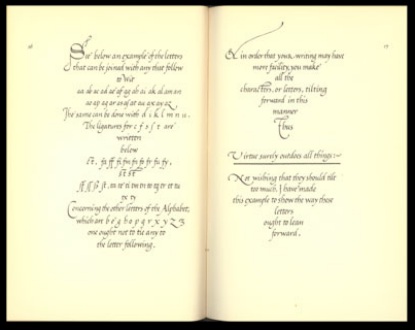 |
The First Writing Book:an English translation & facsimile text of Arrighi’s OPERINA, the first manual of the Chancery hand; New Haven: Yale University Press;London: Oxford University Press, 1955 |
|
John Howard Benson, born in 1901, attended public schools in Newport, Rhode Island, and studied for five years at the Art Students League in New York. He took no formal courses in lettering, but designed some bookplates, title-pages, and other layouts. When a friend gave him Edward Johnston’s Writing & Illuminating, & Lettering he became devoted to the creation of beautiful letters, both in pen and ink and later by cutting letters in stone with mallet and chisel. Starting in the 1930s in the United States there was an interest in the reform of handwriting and a revival of the practice of italic handwriting. John Howard Benson translated the sixteenth-century writing manual of Ludovico degli Arrighi, which has historical and practical interest. Arrighi’s instructions for the formation of letters and the technique of writing are still basic models for modern italic handwriting. |
Writing & Illuminating,
Edward Johnston, With diagrams and illustrations by the author and
Noel Rooke |
 |
| Johnston intended this book for the use of both professional letterers
and students. Johnston presents the development of handwriting and
how to acquire a “formal hand,” as well as dealing with the forms
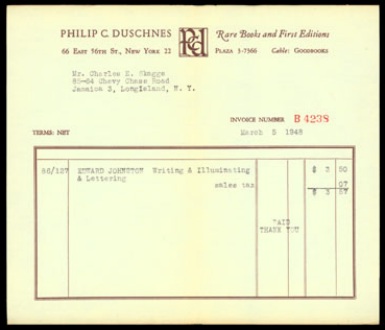
and uses of good lettering. Charles Skaggs started to assemble a fine working library early in his career. He purchased this book in 1948; the invoice from well-known New York rare book dealer Philip C. Duschnes also is shown here. |
|
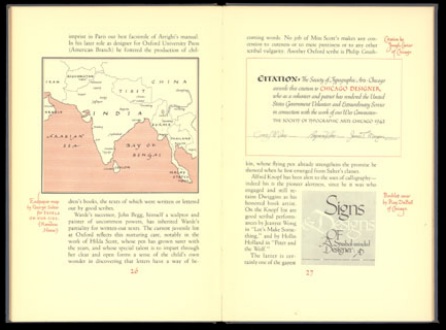 |
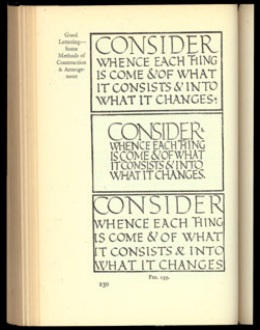
Calligraphy's Flowering, Decay, and RestaurationPaul StandardChicago: Society of Typographic Arts, 1947 Calligraphic scholar and practitioner Paul Standard refers to Arrighi’s sixteenth-century manual of the italic hand in his book, but illustrates the text almost entirely with examples of calli-graphers working in the 1940s. |
| Standard shows how Arrighi’s methods and forms serve well for modern
lettering needs. The lettering shown here is by George Salter, Joseph
Carter, and Ray DaBoll, but the text mentions publisher Alfred A.
Knopf’s use of book artists, including W.A. Dwiggins, the mentor of
Charles Skaggs. Dwiggins’ designs are displayed here.
This book is inscribed to Charles Skaggs: “Presented to Calligraphile CHARLES SKAGGS with the high regard of his fellow-Calligraphile RAY DABOLL June, 1948.” Raymond DaBoll designed this book and “calligraphed” the marginal notes throughout. |
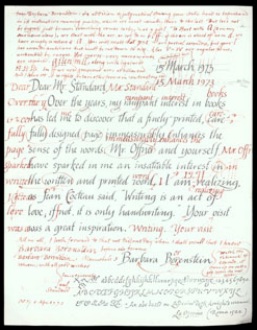
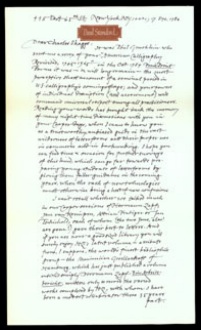 Paul
Standard wrote a long letter to Charles Skaggs on December 17, 1984,
in reponse to Skaggs’ article on calligraphy in Fine Print in October
1984. Standard begins his comments about the article: “For me it was—&
will long remain—the most perceptive short account of a seminal period
in U.S. calligraphy’s coming-of-age; and your powers of individual
description (and assessment) will command universal respect among
all practitioners.” Paul
Standard wrote a long letter to Charles Skaggs on December 17, 1984,
in reponse to Skaggs’ article on calligraphy in Fine Print in October
1984. Standard begins his comments about the article: “For me it was—&
will long remain—the most perceptive short account of a seminal period
in U.S. calligraphy’s coming-of-age; and your powers of individual
description (and assessment) will command universal respect among
all practitioners.”
|